BySimon Chadwick ,
Contributor.
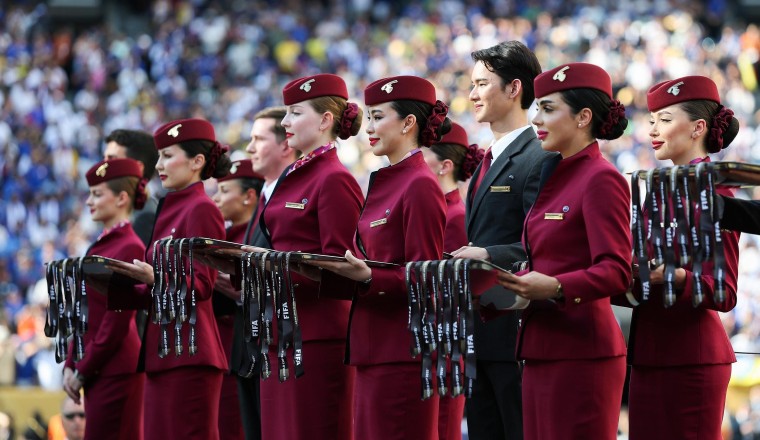
Forbes contributors publish independent expert analyses and insights. Professor of AfroEurasian Sport, geopolitical of sport specialist.Follow AuthorMay 12, 2026, 03:38am EDTMay 12, 2026, 03:42am EDT--:-- / --:--This voice experience is generated by AI. Learn more.This voice experience is generated by AI. Learn more. EAST RUTHERFORD, NEW JERSEY - JULY 13: Qatar Airways flight attendants hold the medals following the FIFA Club World Cup 2025 Final match between Chelsea FC and Paris Saint-Germain at MetLife Stadium on July 13, 2025 in East Rutherford, New Jersey. (Photo by Michael Regan - FIFA/FIFA via Getty Images)FIFA via Getty Images
Whichever winning team lifts the World Cup trophy at the end of this summer’s tournament, their medals will be delivered to them by a group of Qatar Airways flight attendants.
It already happened at the 2018 edition in Russia and then again in Doha following the final there in 2022, thanks to Fifa’s Tier 1 global partnership deal with the Gulf airline.
There’s a certain irony to this given that during his first presidential term in office, Donald Trump sought to curb the airline’s growing influence, as well as that of Emirates Airline and Etihad Airways.
State-owned, Qatar Airways has long been subsidised by the country’s government, not least during the pandemic when it received a $2 billion bailout.
Trump felt that Arabian Gulf airlines had gained an unfair competitive advantage on routes into the U.S., which he addressed via measures including a laptop ban on passengers travelling on Gulf region carriers.
A deal was eventually struck between the administration and the airlines, though it serves as a reminder that sponsorship deals have a context and are not simply names that benignly appear on digital signage.
MORE FOR YOUSponsorship At A Time Of Sanctions
This is suitably illustrated by Hyundai-Kia, another corporation that has repeatedly incurred Trump’s wrath, largely due to its success in selling electric vehicles that haven’t been produced in the U.S.
Such was the company’s concern about Trump’s re-election in 2024 that the vehicle manufacturer increased its U.S. political lobbying budget by almost 150%.
During the president’s 2025 Independence Day speech, it was subsequently revealed that South Korea would have a 25% tariff slapped upon it, EVs in particular falling under the spotlight.
Lenovo is a Chinese multinational technology company and the world’s largest personal computer vendor, which will serve as the Official Technology Partner for FIFA, providing the critical infrastructure and AI support at the World Cup.
The company’s largest shareholder is Legend Holdings, which owns approximately one-third of it although Legend in turn is also one-third owned by the Chinese government.
Lenovo’s appearance in cities across America will perturb some U.S. lawmakers who have repeatedly alleged that Lenovo has extensive ties to the People’s Liberation Army and state-directed espionage efforts.
There’ll be similar concerns about FIFA’s Tier 2 and 3 sponsorship roster which includes Hisense, a Chinese electronics and home appliances manufacturing.
Hisense is predominantly state-owned, Qingdao Municipal Government holding a substantial stake in the company, as does Chinese central government via the Hisense Group Holdings Co., Ltd.
It would be interesting to know what assessments have been made by American government around economic and data security, as well as the competitive threats that such brands pose for U.S. domestic industry.
How Saudi Arabia Fits Into The World Cup Sponsorship Picture
FIFA’s array of global partners won’t be all bad news for the U.S., for instance Saudi Arabia’s state own oil corporation – Aramco – has close relations with the America and is one of biggest sponsors that soccer’s world governing body currently has.
In May 2025, Aramco signed 34 preliminary agreements with major U.S. companies worth up to $90 billion, including partnerships with Nvidia for AI infrastructure and ExxonMobil for refinery upgrades.
Aramco is also a cornerstone of Saudi Arabia’s larger commitment to invest nearly $1 trillion in U.S. infrastructure and technology, one element of which will see a $3.4 billion expansion of its Motiva refinery in Texas.
It should therefore be no surprise that Saudi Arabia’s national team will be based in Texas for the duration of their participation in the World Cup.
FIFA World Cup Sponsorships Heading Back To The Future
Otherwise, FIFA’s sponsors are redolent of a bygone era.
The last time the World Cup headed Stateside, Coca Cola, McDonalds and Pontiac were among a portfolio of FIFA’s biggest sponsors, appearing alongside trusted Japanese partners such as Canon, Fujifilm and JVC.
Corporations from the Japan have largely drifted away from the global sponsorship scene, although Coke and McDonalds are back again this year accompanied by the likes of Visa (in 1994, it was rival Mastercard that had the right of association with world football’s biggest tournament).
With the billions of eyeballs likely to be watching the World Cup across its duration, there’s an opportunity for Brand America to assert itself as an industrial giant in the face of growing competition from overseas territories, notably East Asia.
The opportunities this potentially presents are already being seized upon, with Fanatics using its deal with FIFA as a springboard for building closer relations with the Swiss-based organisation.
Ahead of this summer’s tournament, it has been announced that from 2031 FIFA will be contracted to U.S. business Fanatics in a deal that covers stickers and other collectibles.
This will bring FIFA’s 50-year relationship with Italian company Panini to an end.
There was a time when a sponsorship would have involved little more than some billboards around the pitch permitters of stadiums used to host World Cup games.
However, such are the complexities and sensitivities of sport in the 21st century, that sponsorship has become tricky terrain through which to navigate.
Countries and rivalries are nowadays the name of the game and nowhere will this be more evident than during this summer’s games in the U.S.




Comments
0 comment