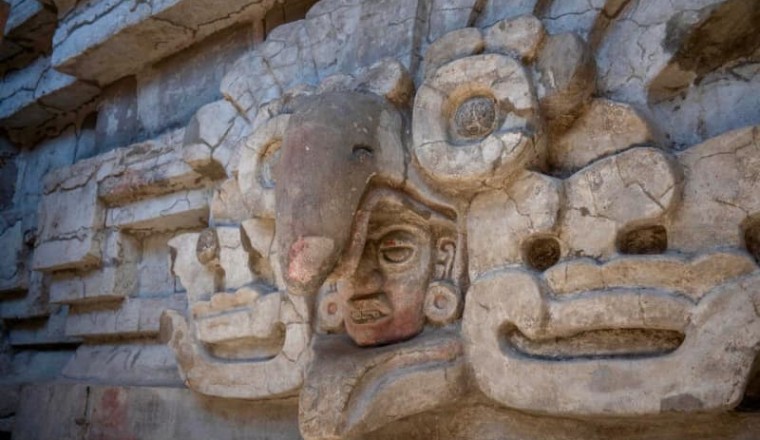
 Owl carving above the entrance to a Zapotec tomb from 600 CE in the Oaxaca Valley, Mexico, February 14, 2026. (photo credit: Screenshot/X/@ccurieldeicaza)
The Zapotecs were a major pre-Hispanic civilization that flourished in Oaxaca from circa 700-500 BC until the Spanish conquest.
A Zapotec tomb from 600 CE was discovered by Mexico’s National Institute of Anthropology and History (INAH) in the Oaxaca Valley, Mexican President Claudia Sheinbaum announced during a late January press conference.
The Zapotecs were a major pre-Hispanic civilization that flourished in Oaxaca from circa 700-500 BC until the Spanish conquest. The indigenous Zapotec peoples today are their modern descendants.
AdvertisementAdvertisementThe find constitutes the most “significant archaeological discovery of the last decade in Mexico,” according to Sheinbaum.
“This is an exceptional discovery due to its level of preservation and the insights it provides into Zapotec culture: its social organization, funerary rituals, and worldview, preserved in its architecture and mural paintings,” Mexico’s Culture Minister Claudia Curiel de Icaza further explained in her own social media post.
“A powerful testament to the ancient grandeur of Mexico, which is now being researched, protected, and shared with the public.”
An owl, which to the Zapotec’s symbolized night and death, is carved into the stone above the entrance to the antechamber, its beak curved and protruding to cover the painted face of an individual believed to be a Zapotec lord, according to a statement by the INAH.
AdvertisementAdvertisementIt is possible that the painted face was the “portrait of the ancestor to whom the tomb was dedicated, and to whom his descendants turned as an intercessor with the divinities,” the INAH explained.
Calendrical names are carved into the threshold’s structural lintel (upper beam that spans an opening), INAH described, adding that both a male and female figure, “perhaps the guardians of the place,” are carved into the threshold’s jambs.
Each figure is dressed in a headdress and carrying artifacts in both hands, INAH said.
Murals painted in ochre, white, green, red, and blue were found on the walls of the burial chamber, the statement added, depicting an in situ “procession of figures carrying bags of copal and walking toward the entrance.”
INAH to continue preserving, researching the finds
According to the INAH, the tomb is being compared with other Zapotec funerary complexes, to further understanding of the “social, artistic, and symbolic complexity of this civilization.”
AdvertisementAdvertisementConservation and preservation of the site, as well as continued research, are being carried out by an interdisciplinary team from the INAH Oaxaca Center, the statement went on.
More in World

The Best British fighter planes ever
 Autocar
Winter Olympics 2026: China reportedly paid U.S.-born athletes, including Eileen Gu, nearly $14 million
 Yahoo Sports3.8K
What the Soviet Union thought as it watched Operation Desert Storm
 WE ARE THE MIGHTY232
Bombshell Report Finds Putin Lost Twice the Number of Troops In January as the Soviets Lost In 10 Years Fighting In Afghanistan
 Mediaite1.9K
Such work includes stabilizing the burial chamber’s mural “whose condition is delicate due to the presence of roots, insects, and abrupt changes in environmental conditions.”
As well, the statement further noted, “ceramic, iconographic, and epigraphic analyses are being developed, as well as physical anthropology studies, in order to deepen knowledge of the rituals, symbols, and funerary practices associated with the tomb.”













Comments
0 comment